Please join us for a Q&A with Donna Everhart, author of Women of a Promiscuous Nature.
Please help me welcome Donna Everhart to the BookBrowse Community Forum.
Donna is the USA Today bestselling author of authentic, vivid Southern fiction, including the Southeastern Library Association Award-winning The Road to Bittersweet, Indie Next Pick and Amazon Book of the Month, The Education of Dixie Dupree, The Forgiving Kind, The Moonshiner’s Daughter, and The Saints of Swallow Hill. When the Jessamine Grows, was an Amazon Top Ten Book of the Month.
Her latest novel, Women of a Promiscuous Nature, was released in January 2026, and was featured as a BookBrowse Book Club Pick.
Born and raised in Raleigh, North Carolina, she now lives with her husband in the small town of Dunn, North Carolina where she is currently working on her next novel. She’s a member of the North Carolina Writers’ Network, Historical Novel Society, and is the spokesperson for the MaryJanesFarm Book Club.
Please use this space to ask Donna questions about her work. As a reminder, to reply to an existing comment, click the grey Reply on the right side under the comment. To ask a new question, click the blue Reply button a little lower down.
Donna: Thank you so much for agreeing to chat with us. Is there anything you’d like to add to your bio? Anything you’d like to tell us about yourself before we get rolling?
Good morning, and thank you so much for having me! I’m excited to be here with you all for a few days and to answer any questions you might have - about this book, my writing, my life (a little nutty right now, it seems) and whatever else comes to you you’re just dying to ask!
Thank you Kim, for that question. Yes, I think what I’d like to add to the bio is that Women of a Promiscuous Nature was also an Indie Next Pick for February 2026, and a Library Reads Top Ten Pick for January 2026. These are two leading industry related acknowledgments that made me very happy.
One other thing I’ll add about myself is that I’’m a Stage IV cancer survivor - diagnosed back in 2017 with CRC. I was once a runner - and did two marathons among many other road races. I love baking - although I’ve cut way back on that because my hubby (married for almost 30 years) is pre-diabetic. And I especially love my two little Yorkies - Daphne and Chloe! 
I thought your book was extraordinary - how did we not learn about the US government and its American Plan in American History?! So glad you have brought this into the light. I am wondering if it was hard to write from the perspective of the matron in charge and her beliefs that she was doing the right thing for these women?
1 Like
Good morning, Donna! Great to have you here.
When we were chatting over the weekend, you mentioned you were “heading to Durham, NC today to receive an award in creative fiction from the General Federation of Women’s Clubs-NC.” Congratulations! Tell us more about the award & the event!
How did you learn about the American Plan in the first place, and what led you to consider it a subject for one of your novels?
Congratulations on surviving your cancer. It looks like the diagnosis came the same year your second book, The Road to Bittersweet, was published (2017) - and yet you went on to write another five books (!). How did the diagnosis and treatment impact your career?
Thank you for that question and for reading the book!
It actually wasn’t difficult because the research about these women is what inspired me to write from this particular perspective, and for the very reasons you mention. It seems really shocking, but I can understand their “mission.” When we think back on history and the changes to what are societal norms depending on the time, it makes sense that what they did would be favorable, if not recommended. After all, these were state run “programs” under the umbrella of the U.S. government’s approval.
I look at it this way. Once upon a time it was perfectly acceptable for families to make a field day/picnic out of a hanging. This included bringing a basket of food and the children. More recently (like 1928) it was common for people to become enthralled over a death scene and snag “souvenirs” for themselves as they passed by the grotesque scenes. There are tons of examples of what was “okay" in the past and would not pass muster now. 
That’s right! What a tremendous honor that was! I received the Lucy Bramlette Patterson Award in Creative Fiction from that organization. I was invited to attend their yearly convention and to speak to them, which I did. The Lucy Bramlette Patterson award was created in 2002, and is representative of a former member of the Women’s Clubs, Lucy Bramlette Patterson, who was a huge literacy advocate. The award is given out each year to a NC writer, and a scholarship in that writer’s name is given to a writing student at women’s college, called Salem College in Winston-Salem, NC.
The event had about one hundred attendees, who were there mainly for the business of the Women’s Clubs in NC with various chapters represented. I admit, I was a bit intimidated by this roomful of prestigious business and education leaders of our state! I have NO idea if I made sense.
I, more or less, stumbled on it. I was expecting to write a book about a girl’s reform school. I wanted to write from the angle of how they got there, versus their time in one. At some point, I looked up the word prostitution. (unfortunately, some girls were young when they went into this work, either because of desperation, no other choices, or fear/intimidation) That word led me to the Chamberlain-Kahn Act passed by Congress in 1918. When I read “State Industrial Farm Colony for Women,” I thought, what the heck is that?! Then I started Googling, and what struck me is I couldn’t find anything on it. But, I kept searching and searching in various ways. First with State Industrial Farm Colony for Women. Farm Colony. Farm for women. Colony for Women. It was BIZARRE how nothing was out there. Most of the time, I’d land on something crazy like “Want to grow your own veggies - there are lots of women farmers!” Craziness like that. What’s REALLY interesting now is the term is associated to my book now when you do a Google Search on it. Not 100%, but the information is definitely more readily there.
Beyond that, at some point I landed on the Biennial Reports for the facility in Kinston NC. Of course I ordered some - for the years 1936, ‘38’ ‘40 and ‘46. Those were eye-opening. Even more were the non-fiction books like Bad Girls at Samarcand; Sexuality and Sterilization in a Southern Juvenile Reformatory, but more specifically, The Trials of Nina McCall; Sex, Surveillance and the Decades Long Plan to Imprison “Promiscuous” Women by Scott W. Stern. Once I got my hands on those resources, and understood just how horrific it was for women to be held in one of these facilities, I knew I had to write about it.
You’re absolutely right. I was about to start promoting The Road to Bittersweet when I learned (July 2017) this bizarre lump that seemed to suddenly show up in my upper leg (lymph node involvement) was cancer. Without a doubt the diagnosis was shocking. The treatment was brutal (30 radiation treatments) and weeks of chemo. (some of it administered by way of a continuous pump - no fun at all) I got through it, quite honestly, by focusing on my writing. I was bent on continuing this new career I found myself in after 35 years of working in IT. I had another metastasis to my left lung in Sept 2018 that required surgery. Then, another bout of chemo in 2019 when spots showed up on my liver. In July 2022, during another routine scan, they determined because of their stability they were benign - which of course changed my outlook/outcome dramatically. I think I might have written with more fervor because of a determination to not let cancer become the THING that dictated what I would or wouldn’t do. I still get scans every six months. I still live in pockets of six months (scan good? Phew! Okay! I don’t need to think about that for a while!) Cancer never lets you forget it could come back at any time. The thing is, I think the longer one goes without a recurrence, the better the odds. As of July, it will be nine years since diagnosis.
Donna, I’m in the beginning chapters of Promiscuous, and your writing has captured my emotions already. My questions might be part of the coming storyline, so my apologies if true. I recall in the late 1960s there was a place pregnant teens could be sent in NE Iowa. I’m unsure what happened there, though. My guess is that other states had institutions for unwed young mothers. Might these have been a modified continuation of the earlier practices on which your novel is based?
Also, I recall hearing of past times when women who struggled with extreme issues related to menopause were confined to special facilities. Did your research uncover such practices and facilities?
Personal note: A great aunt was so concerned with whom her daughter was dating (back in the 30s) that she had her sterilized. My aunt often said she didn’t want to be a grandmother left raising a grandchild. This seems so cruel, and was, but as you mentioned in an earlier response, times were different.
Were you able to do most of your research online and by reading books, or did you have to make field trips? Or did you have to dig through library archives?
It seems like there were facilities to address every single issue related to women, doesn’t it?
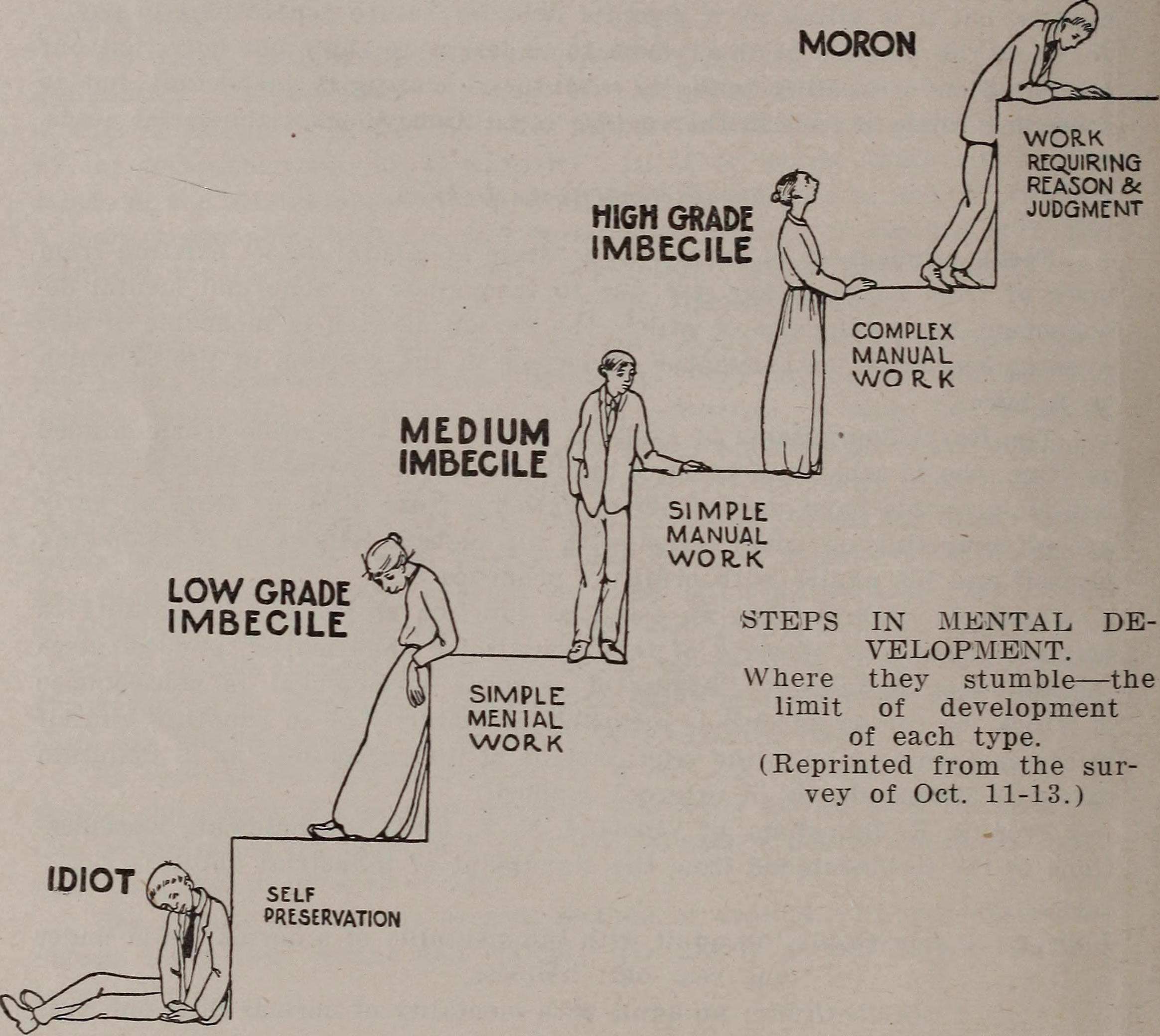
But yes, I recollect about the “homes” where unwanted pregnancies were managed. The biggest focus of Women of a Promiscuous Nature is centered on this idea that women could be surveilled, detained, examined, sent away, and treated - all without due process - under the guise of The American Plan (Chamberlain-Kahn Act). It happened to tens of thousands of women. There was bleed over at the time to have other facilities to deal with the other social/moral endeavors, like unwanted pregnancies, as well as locking up people considered morons, imbeciles and idiots. Consider this graphic that depicts the categories and the “diagnosis” of what they might be capable of doing. This graphic isn’t intended for facilities such as The State Industrial Farm Colony for Women, but more to show the categorization of certain types of individuals and how they might be viewed by those overseeing them. (maybe held at a mental facility)
Yes, I used those two non-fiction books, as well as the biennial reports I mentioned. I also found a couple of thesis papers that were useful. I could have visited both Samarcand and the Farm Colony, but it really wasn’t necessary. The buildings still exist although they’re under different uses/names now.
Wow, thanks for sharing that graphic. My mouth literally dropped open on seeing that. As bad as things are right now, I’m becoming increasingly thankful I wasn’t born 100 years ago.
What was the most shocking thing you learned during your research (other than, of course, the fact that “women could be surveilled, detained, examined, sent away, and treated - all without due process”)? Is there anything in particular that stands out?
Women of a Promiscuous Nature feels like a departure in some ways from your earlier novels – more main characters, an institutionalized setting, more basis on a specific historical policy, etc. Was this a deliberate choice – “I need to expand my writing” – or did it just make the most sense in terms of the story you wanted to tell?
Such a shame. Some “low life scoundrels” had to create that chart, too!
I visited China in the early 1990s when the one child law was fully apparent. We were told that a woman in each village/town had the monthly job of surveying every woman of child bearing age to record her last menstrual cycle. Government control!